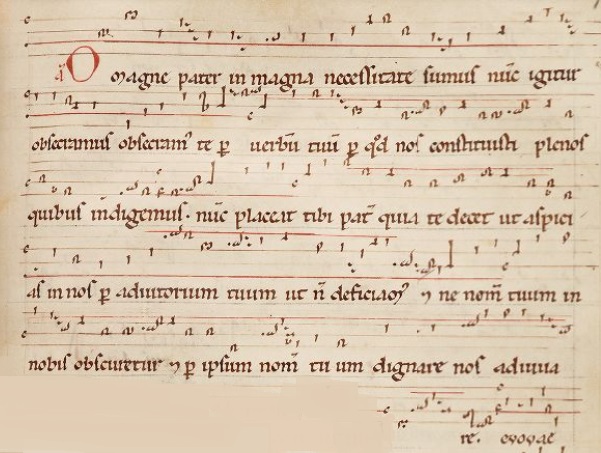
#45 is an antiphon to God the father. This chant will feature in Ut Sol‘s upcoming concerts in the Netherlands on February 2 and 3. See here for more details.
o magne pater
O great father, we are in great need. Therefore we now beg you, we beg you through your word, by which you made us, and that fills us with everything that we need: now may it please you, Father, for it suits you, to regard us through your help, so that we do not fail and that your name does not grow dark in us; and deign, through your own name, to help us.
I have revised my revisiting of alleluia – o virga mediatrix. Here’s the new version:
alleluia – o sweet illumination
alleluia o branch and mediator your holy body has overcome death and your belly has illuminated every creature in the beautiful flower that rises from the sweet wholeness of your sealed chastity
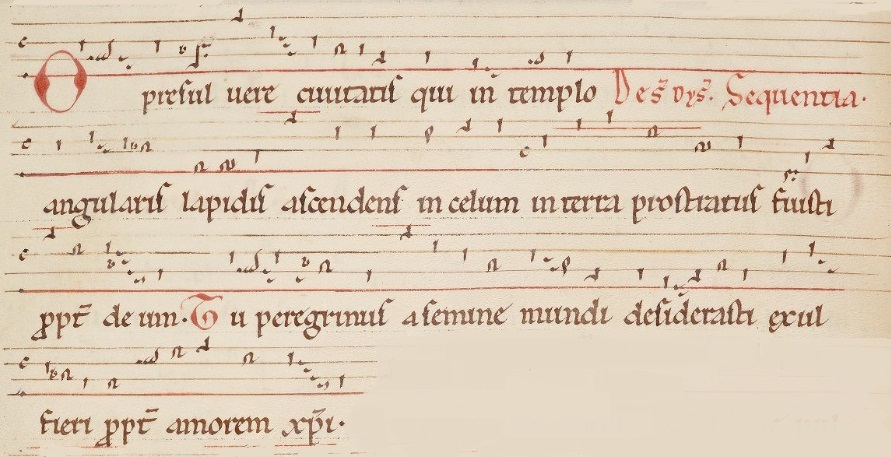
I have finally finished my revisiting of o presul vere civitatis, a sequence in honour of Saint Disibod. Sequences are long chants (this one is made up of 12 melodically-paired sections) and they would have been sung just before the Gospel, as part of the Eucharist. I presume that this one would have been sung on Saint Disibod’s feast day.
The chant is a poetic ode to Saint Disibod. It’s like a ballad, and I have chosen to accompany most of it with a gentle (and at the end quite funky!) rhythm in the cellos, as it tells its story.
o presul – the smoke of spices
O Bishop of the true city, who, mounting heavenward on the temple of the cornerstone, were laid low on earth for the sake of God.You, an alien from the race of this world, longed to become an exile for the love of Christ.
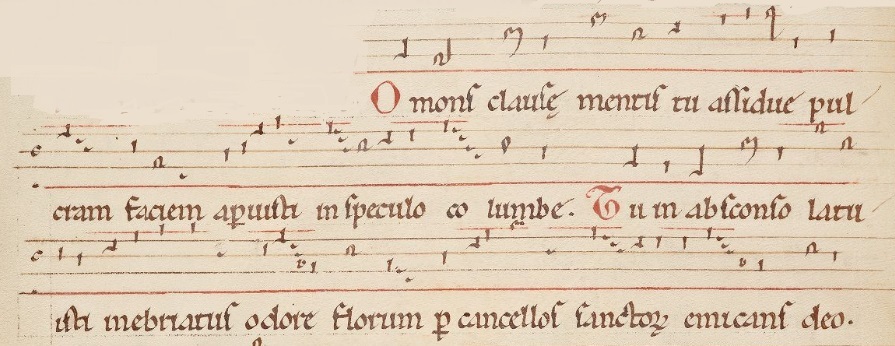
O mountain of the mind enclosed, you continually revealed your beauty’s aspect in the mirror of the dove.In the secret place you hid, drunk with the scent of flowers, through the trellis of the saints glinting towards God.
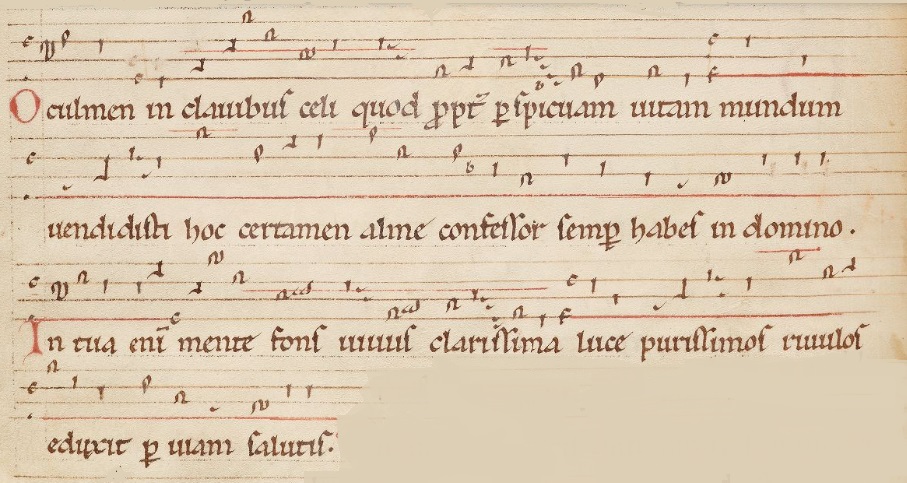
O summit among heaven’s keystones, that for the sake of transparent life sold the world, this contest, gracious confessor, is with you forever in the Lord. For in your mind the living spring with its most radiant light brought forth the purest rivulets on the path of salvation.
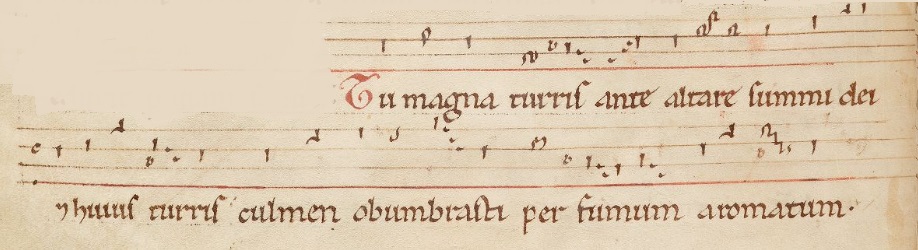
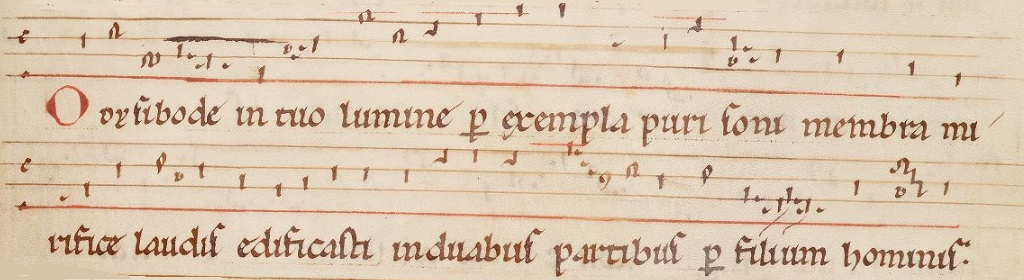
You are a great tower before the altar of the highest God, and to the summit of this tower you gave shade with the smoke of spices.O Disibod, in your brightness, through images of pure sound, wondrously, you built the limbs of praise, two-part music, through the Son of Man.
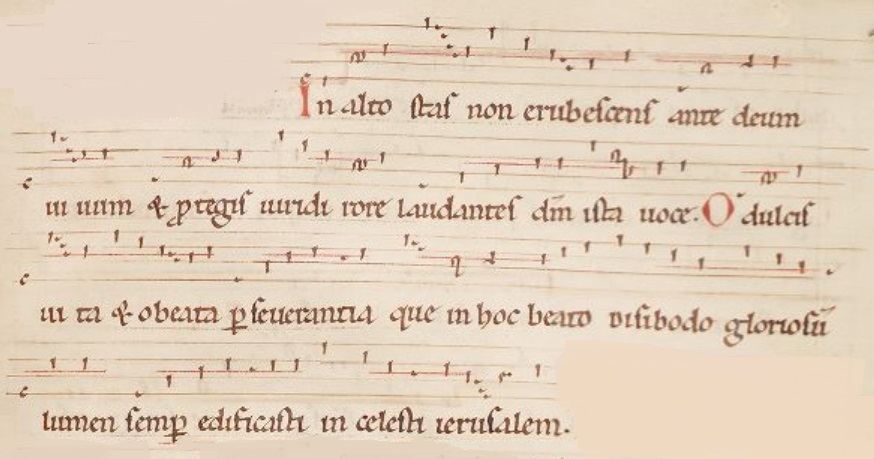
You stand on high, not blushing before the living God, and with green dew you protect those praising God with this song. O gentle life and blessed perseverance, which in this blessed Disibod always built the most glorious brightness in the heavenly Jerusalem.
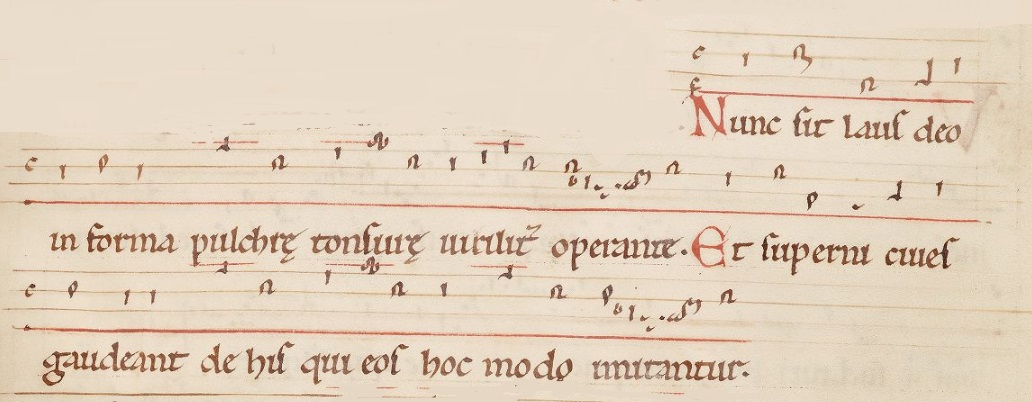
Now praise be to God, and in the form of that priestly beauty, as he toils manfully.Let heaven’s citizens rejoice because of those who imitate them in this way.
Here is a sequence in honour of Saint Disibod, whose Saint’s day is coming up on July 8th. Disibod had a special significance for Hildegard and this is one of five chants that she dedicated to him.
The sequence is made up of 12 melodically paired sections. I’m looking forward to revisiting it.
O Bishop of the true city, who, mounting heavenward on the temple of the cornerstone, were laid low on earth for the sake of God.
You, an alien from the race of this world, longed to become an exile for the love of Christ.
O mountain of the mind enclosed, you continually revealed your beauty’s aspect in the mirror of the dove.
In the secret place you hid, drunk with the scent of flowers, through the trellis of the saints glinting towards God.
O summit among heaven’s keystones, that for the sake of transparent life sold the world, this contest, gracious confessor, is with you forever in the Lord.
For in your mind the living spring with its most radiant light brought forth the purest rivulets on the path of salvation.
You are a great tower before the altar of the highest God, and to the summit of this tower you gave shade with the smoke of spices.
O Disibod, in your brightness, through images of pure sound, wondrously, you built the limbs of praise, two-part music, through the Son of Man.
You stand on high, not blushing before the living God, and with green dew you protect those praising God with this song.
O gentle life and blessed perseverance, which in this blessed Disibod always built the most glorious brightness in the heavenly Jerusalem.
Now praise be to God, and in the form of that priestly beauty, as he toils manfully.
Let heaven’s citizens rejoice because of those who imitate them in this way.
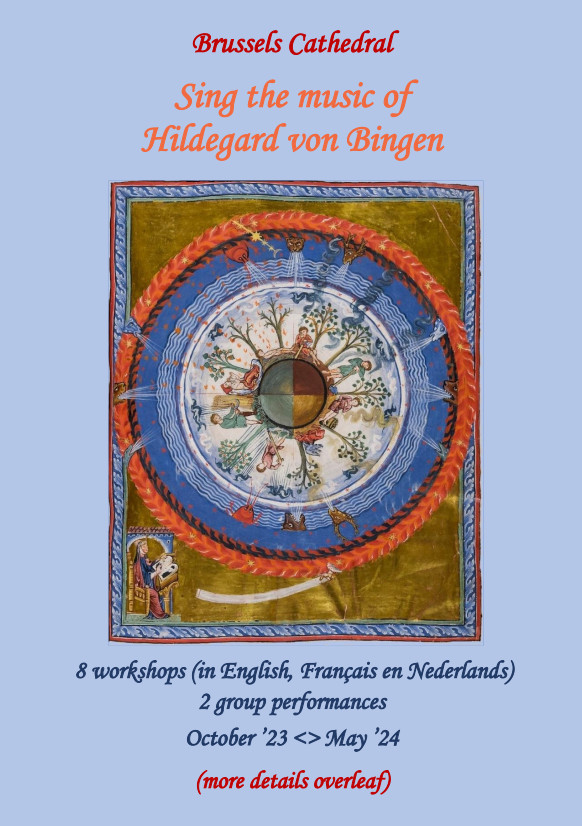
During the next academic year, I will be running a series of monthly workshops (given in English, French and Dutch) that will teach you to sing Hildegard von Bingen from her original notation. Once you’ve tried it you’ll never look back 🙂
Music was a central part of Hildegard’s life – she considered it to be a foretaste of paradise. This project concentrates on her Marian chants, which we will explore using two magnificent 12th century manuscripts.
Why learn to read her language?
Singing Hildegard from modern editions is problematic because our modern notation encourages a note-by-note interpretation of her melodies. Using the original notation as a basis frees up your mind and your voice as you follow the direction of the musical phrases, shown graphically on the page. It is a language that once learnt is never put aside!
Who should come?
Many different kinds of singer will benefit from these workshops, from music students and professionals interested in learning about medieval music and Hildegard’s compositions, to musical amateurs drawn by her brilliance. The only technical requirement is that you can pitch and hold a note, because we will learn the language of the notation together.
Practicalities:
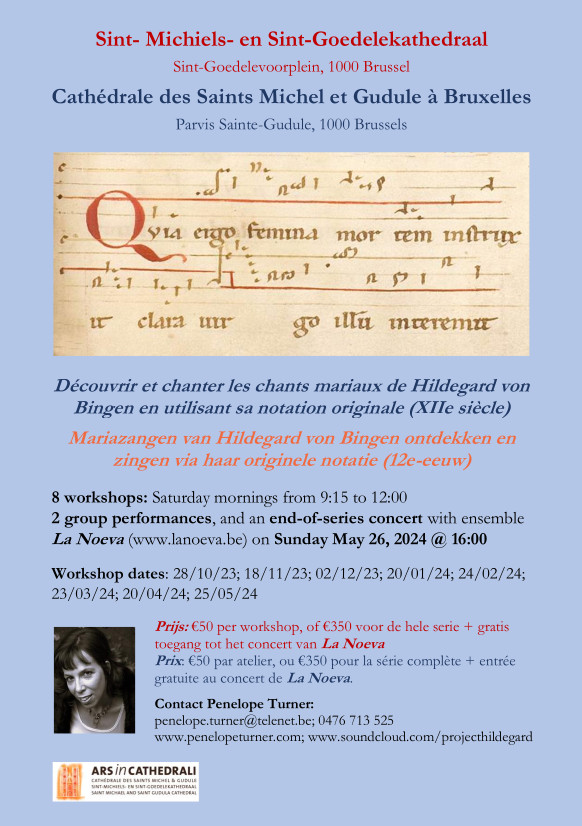
There are eight workshops planned between October 2023 and May 2024 (dates on the flyer), all in the beautiful Brussels Cathedral on Saturday mornings between 9:15 and 12:00. There will also be 2 group performances, one mid-way through the series and one at the end, and there will be an end-of-series concert given by the ensemble La Noeva on Sunday May 26, 2024 at 4pm.
Because of the nature of these workshops, I am limiting the number of participants to 10. First come first served! Please contact me (penelope.turner@telenet.be or +32 476 713 525) and I will send you a registration form. The basic prices are mentioned on the flyer, but please note that I am offering a reduction of 25% for professional musicians, the unemployed and the over 65s, and a reduction of 50% for students.
Big thanks to the Cathedral for hosting this project. I can’t wait to share this wonderful music with you!