
A chant written for Saint Boniface, whose feast day is June 5th.
If you’re curious to hear another version, here is Stevie Wishart’s recording (© SW), featuring the beautiful voice of Jocelyn West as the soloist in the beginning.
o bonifaci
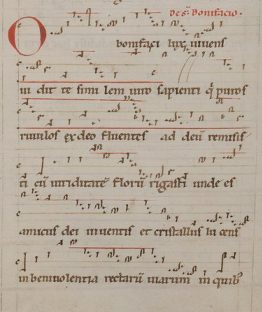
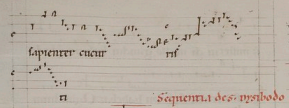

A chant written for Saint Boniface, whose feast day is June 5th.
If you’re curious to hear another version, here is Stevie Wishart’s recording (© SW), featuring the beautiful voice of Jocelyn West as the soloist in the beginning.
o bonifaci
A chant written in honour of the holy trinity, I knew that I wanted this one to be for three voices in its revisited form. It’s turned into a sort of homage to the great choral tradition, with definite echos of Charles Stanford, a composer whose works I first had the pleasure to sing in Trinity College Chapel, Cambridge.
laus trinitati – in the choral tradition
laus trinitati que sonus et vita ac creatrix omnium in vita ipsorum est et que laus angelice turbe et mirus splendor archanorum que hominibus ignota sunt est et que in omnibus vita est.
I had hoped to record this in time for Trinity Sunday, which was June 7th this year. Still, here it is with a little delay.
I was interested to see the symbol that is usually used in the Dendermonde manuscript to indicate a flat (notably before a B) occurs here in front of a couple of Ds. My hypothesis now is that this symbol is used to show that the note is lower than you might otherwise think. I first came across it used like this in o felix apparicio (see my previous post). As I sing more of her chants, I will be able to test my theory.
laus trinitati
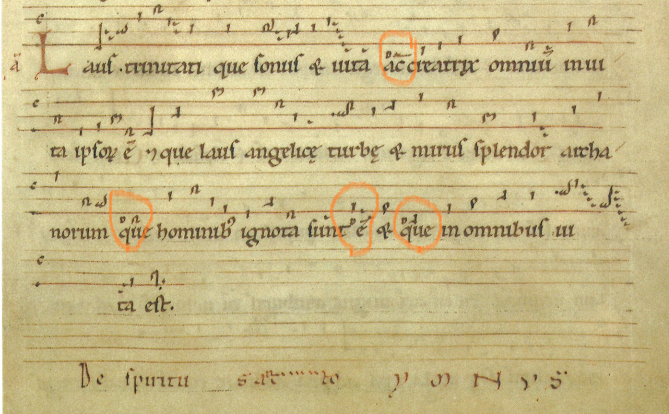
laus trinitati que sonus et vita ac creatrix omnium in vita ipsorum est et que laus angelice turbe et mirus splendor archanorum que hominibus ignota sunt est et que in omnibus vita est.
The creation process is frustrating, demanding and utterly wonderful. How something starts as one thing and then grows step by step, taking on a life of its own.
Someone close to my heart asked me to describe how this one came about. It started with a freely sung chant to the holy spirit, recorded a cappella (see Project Hildegard #9). Listening back to it, I realized that, even though it was sung with no tempo at all in mind, there was a tempo that kind of worked with a lot of the phrases. Once I’d discovered that, I went about creating a rhythm section. My cello has proved invaluable for this – with a pizzicato groove grounded by using its sound box as a drum. This chant is in sections and each different section inspired a slightly different pizzicato bass.
After that, it was a question of deciding what was missing. It had got so funky by this stage, that I played around with some ad lib cello, and the next voice came to life. Too much for the whole song, so I used it in alternate sections. And for the other sections I tried out various sung possibilities, going in the end for a simple, sustained line that serves text.
It’s not perfect, and deciding when to stop fiddling around with it was difficult. (There’s always a cello ad lib just around the corner that will work better than what you’ve got; the rhythm can always be tightened up, the tuning – well, I haven’t worked out how to use technological help in that regard without it being really noticeable, so what I play/sing is what you get.) But here it is. I hope you like it.
o ignis spiritus – may the funky spirit be with you
O ignis spiritus paracliti vita vite omnis creature sanctus es vivificando formas. Sanctus es ungendo periculose fractos sanctus es tergendo fetida vulnera.
O spiraculum sanctitatis o ignis caritatis o dulcis gustus in pectoribus infusio cordium in bono odore virtutum. O fons purissimus in quo consideratur quod deus alienos colligit et perditos requirit.
O lorica vite et spes compaginis membrorum omnium et o cingulum honestatis salva beatos. Custodi eos qui carcerati sunt ab inimico et solve ligatos quos divina vis salvare vult.
O iter fortissimum quod penetravit omnia in altissimis et in terrenis et in omnibus abyssis tu omnes componis et colligit. De te nubes fluunt ether volat lapides humorem habent aque rivulos educunt et terra viriditatem sudatt.
Tu etiam semper educis doctos per inspirationem sapientie letificatos. Unde laus tibi sit qui es sonus laudis et gaudium vite spes et honor fortissimus dans premia lucis.
I’ve not heard any interpretations of this one sung at pitch. Most people start it on D or F, or even F#. But there are two pretty similar chants to the Holy Spirit that come one after the other in both the Riesencodex and the Dendermonde manuscript, and this one clearly begins on A, while the other begins on D. So, although it’s taken me into the stratosphere, I’ve gone for the original pitch. It’s interesting to wonder whether Hildegard wrote it for some particularly high-voice nuns, or – an octave down – for low (mens?) voices. In any event, I like to think that she intended the fiery spirit to shoot up to the heavens…
o ignis spiritus paracliti
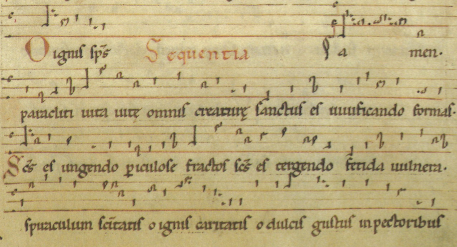
O ignis spiritus paracliti vita vite omnis creature sanctus es vivificando formas. Sanctus es ungendo periculose fractos sanctus es tergendo fetida vulnera.
O spiraculum sanctitatis o ignis caritatis o dulcis gustus in pectoribus infusio cordium in bono odore virtutum. O fons purissimus in quo consideratur quod deus alienos colligit et perditos requirit.
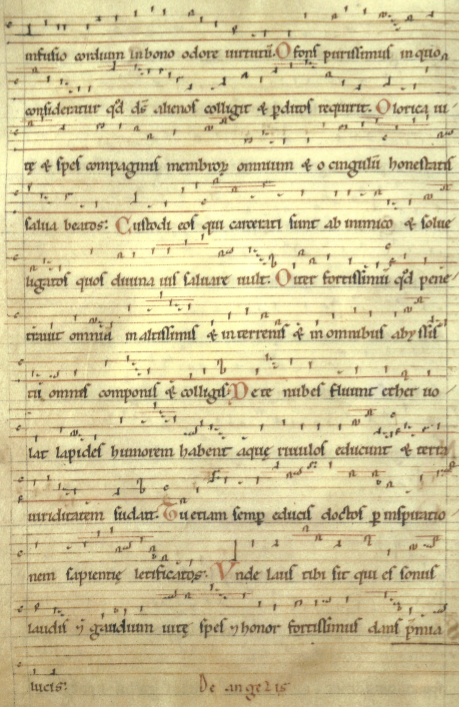
O lorica vite et spes compaginis membrorum omnium et o cingulum honestatis salva beatos. Custodi eos qui carcerati sunt ab inimico et solve ligatos quos divina vis salvare vult.
O iter fortissimum quod penetravit omnia in altissimis et in terrenis et in omnibus abyssis tu omnes componis et colligit. De te nubes fluunt ether volat lapides humorem habent aque rivulos educunt et terra viriditatem sudatt.
Tu etiam semper educis doctos per inspirationem sapientie letificatos. Unde laus tibi sit qui es sonus laudis et gaudium vite spes et honor fortissimus dans premia lucis.